
Six months of school fees for one child
A privately funded pilot to cover school tuition fees for one child for six months, with confirmation from the school.

First India Pilot Report: School Access for One Child
For many families in India, education is shaped not only by a child’s willingness to learn, but also by whether school fees can be paid at the right moment. This completed pilot helped one child continue learning at St. Anne’s Nursery School without interruption.
For Rathna, a hardworking housekeeper in Bengaluru, education is one of the most important hopes for her son’s future.
Through this first India pilot, The Social Project Foundation connected private member funding with a concrete need, covering six months of tuition directly through the school. The support was verified during school visits, documented with official confirmation, and followed by a family story that explains why small, precise education support can matter.
Why This Support Matters
A school-fee payment can look small from the outside (depending on who looks), but for a family it can mean stability: a child stays in the same classroom, with familiar teachers, friends, and routines.
During our time with Rathna’s family, we saw how much care and hope surrounds both children. Education support is one way to protect that hope and reduce pressure on parents who are already doing everything they can.
The visit also reminded us that schools can be more than classrooms. They can become trusted local places where children learn, express themselves creatively, and grow with support from adults around them.
This is why school access remains an important focus for future projects: it combines immediate practical help with long-term potential for children, families, and communities.
School is more than a place where children learn letters and numbers. It can provide routine, protection, trusted adults, creative activities, friendships, and the confidence that comes from being part of a learning community.
Why Private School Support?
Although government schools are available in India and provide free education, many families choose to enroll their children in low-cost private schools whenever financially possible.
In discussions with the family, it became apparent that Dhanushkumar benefited from the smaller learning environment and increased individual attention available at his current school. The family expressed a strong desire to continue his education there despite the financial burden.
Across India, many parents make significant financial sacrifices to send their children to private schools, often due to perceived advantages such as smaller class sizes, more personalized attention, English-medium instruction, and a structured learning environment. This trend is particularly common in urban areas and among families seeking better educational opportunities for their children.
The purpose of this support is not only to cover tuition fees, but also to help ensure continuity in the student’s educational environment during a critical stage of early childhood development.
Become a Long Term Sponsor
Education is one of the most effective ways to break the cycle of poverty. By becoming a sponsor, you can help provide not only tuition, but also the essential resources a child needs to learn, grow, and succeed.
Example Monthly Support Budget per Child at this privat school
School tuition: €14–20
Books and learning materials: €3–5
School supplies and stationery: €2–4
Uniform and clothing fund: €2–3
Transportation and miscellaneous costs: €2–4
Total recommended sponsorship: approximately €25–35 per month
A sponsorship at this level can help ensure that a child remains in school, has access to learning materials, and can participate fully in education without placing an unsustainable burden on their family.
Together, we can move beyond short-term aid and create lasting opportunities through education.
From School Fees to Education Hubs
The payment of school fees solved one immediate barrier. The larger opportunity is to build a repeatable model: identify a real need, connect the right supporters, work with local partners, document the outcome, and turn individual help into long-term educational pathways.
What education support can enable
Continued school access and stable classroom routines
A protected place for early learning and social development
Creative expression through drawing, play, and learning materials
Relief for families carrying education costs alone
A foundation for future education-focused projects
This pilot has been completed and documented.
The school-fee payment was made directly to St. Anne’s Nursery School and verified through school confirmation, receipt documentation, and a consent-based family report.
Our next step is to use what we learned from this first pilot to shape more reliable education support and, in the long term, help create learning environments where the next generation can grow safely and creatively.
Project Updates
Friday, 17 June 2026 – Initial School Visit
This week, we visited St. Anne’s Nursery School in Bengaluru to meet Dhanushkumar, his teachers, and his family. Seeing the classroom firsthand and speaking directly with the school helped us better understand the importance of continued educational support. Following the visit, we approved funding for the second half of the school year. Once the payment is completed in the coming weeks, Dhanushkumar’s tuition fees will be covered through March 2027, helping ensure uninterrupted access to education.
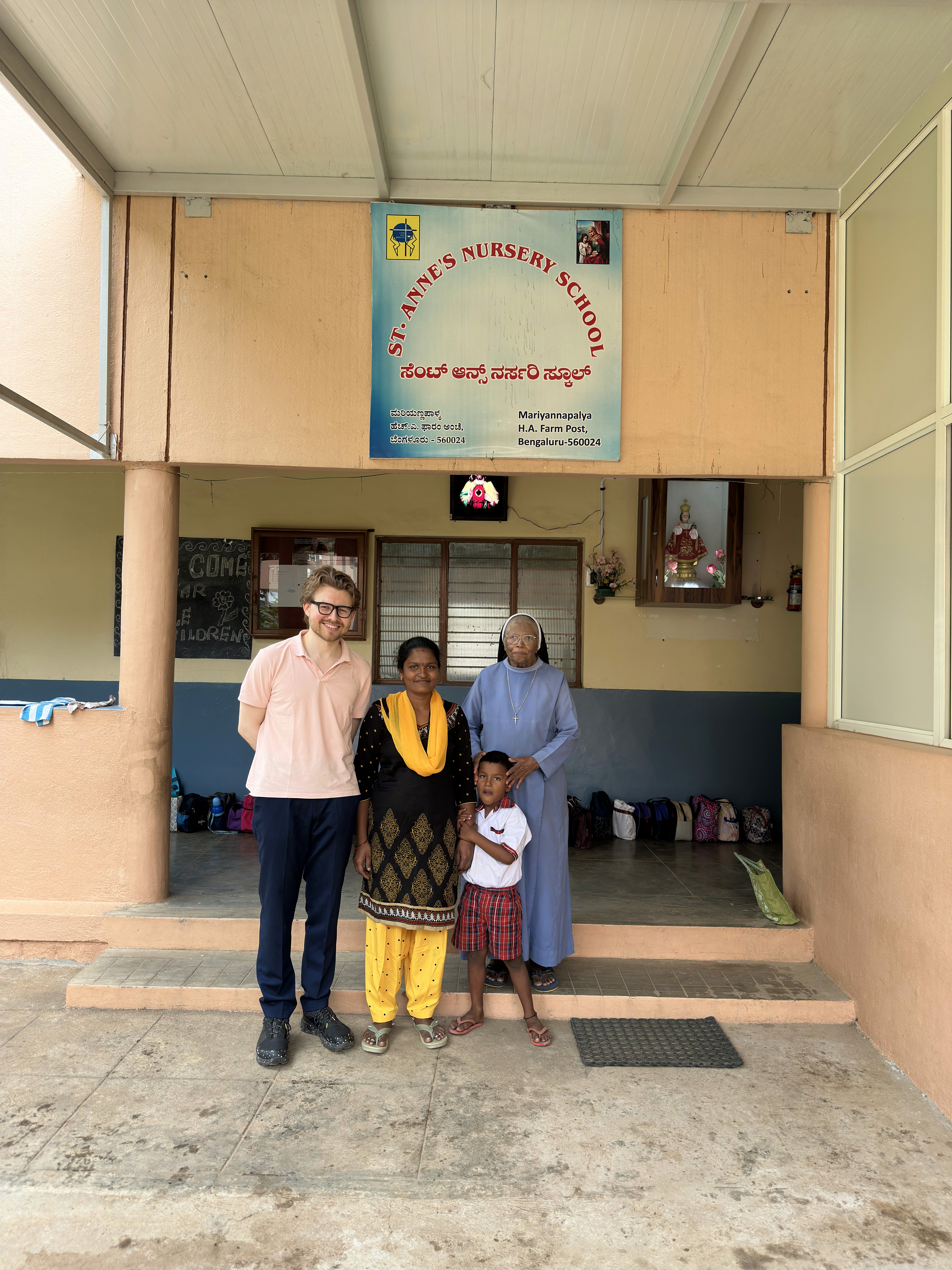
The photos below show the school courtyard at St. Anne’s Nursery School and a group photo taken during our visit with Rathna, her son Dhanushkumar, one of the teachers, and Tim from The Social Project Stiftung.

Sunday, 21 June 2026 – Family Engagement & Community Engagement
On June 21, 2026, we were kindly invited by Dhanushkumar’s family to spend time with them at their home in Bengaluru. Over lunch, we had the opportunity to learn more about their daily life, their hopes for their children, and the important role education plays within the family. The visit provided valuable insight into the realities many working families face while striving to provide the best possible opportunities for their children.
During the afternoon, we spent time with both children, shared gifts, and enjoyed seeing their different personalities emerge. While one eagerly explored colouring books and art materials, the other was more interested in active play and interaction. The family’s warmth, generosity, and commitment to their children’s future left a lasting impression on us. The photos below offer a small glimpse into the family’s life and the relationships that form the foundation of this project.


Wednesday, 24 June 2026 – Second School Visit & Completion of the Education Support Project
During our second visit to St. Anne’s Nursery School in Bengaluru, the final phase of the project was successfully completed. The tuition fees for the second half of the 2026–2027 academic year (November 2026 to March 2027) were paid directly to the school in accordance with its standard fee collection procedures.
Throughout the visit, beneficiary information and school records were verified in cooperation with the school administration. We met with members of the teaching staff, including Sister Sagaya Mary B., Sister Benigna, and Mrs. Usha, to learn more about the school’s educational approach, the challenges faced by students from low-income families, and the needs of the local community. We also gained insight into the school’s admission procedures and student enrollment records.
To ensure maximum transparency and accountability, the school completed and signed the School Fee Confirmation & Enrollment Confirmation, which was officially stamped by the Headmistress. An independent witness also verified the cash handover, and the school issued its official tuition fee receipt confirming payment for the supported student.
During the visit, photographs of the school campus, classrooms, and learning environment were taken with the school’s permission. We observed lessons in progress, documented the educational setting, and collected additional information that will support future project reporting and potential partnerships. The school currently provides education for approximately 70 students across three kindergarten levels: Pre-Nursery, Lower Kindergarten (LKG), and Upper Kindergarten (UKG).
This visit marked the successful completion of The Social Project Stiftung’s first education support project in India and established a strong foundation for future collaboration with the school and the local community.


Our other Projects
Take a look
